
How to Choose a PPF Manufacturer: 8 Things to Check (2026 Guide)
Published by Shanghai ECOFILM Material Technology Co., Ltd. — a full-chain TPU PPF manufacturer in Shanghai, China.
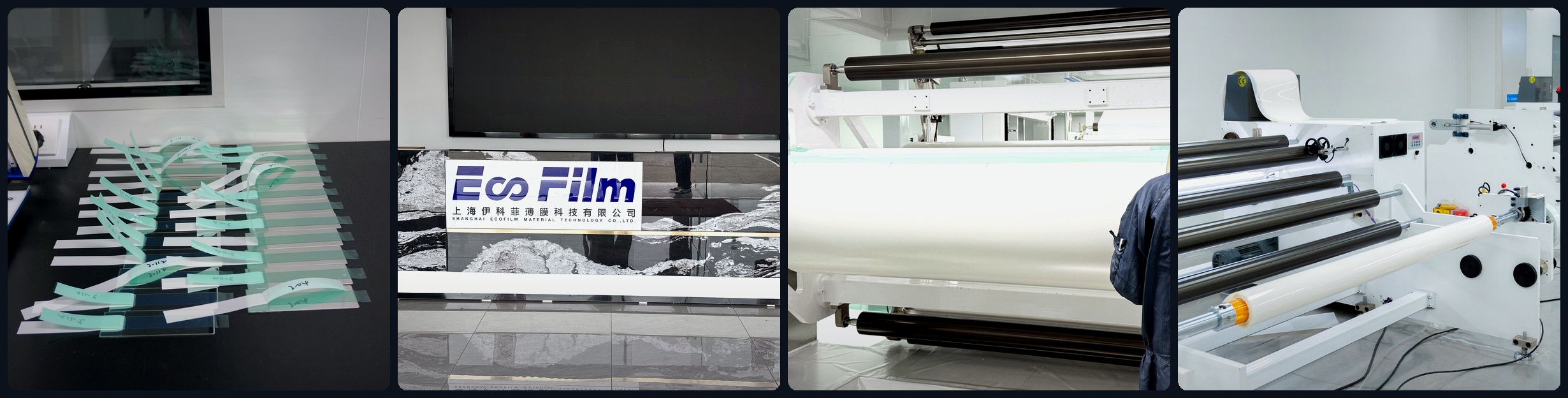
Paint protection film (PPF) is a fast-growing category, and more distributors and installers are sourcing directly from China factories. But not all "PPF factories" are equal. Some suppliers buy finished film and re-roll it. Others produce the film from raw resin — and that difference decides your profit margin, your quality consistency, and your brand's reputation.
Whether you are a distributor, an installer, or a brand owner planning a private label, here is the 8-point checklist we use ourselves when we audit raw-material and film suppliers. Walk through these before you place your first order.
1. Check what the film is actually made of: TPU, PVC, or "TPU-like"?
The substrate is the film's foundation. Real PPF is made of aliphatic TPU (thermoplastic polyurethane) — it self-heals from light scratches, resists yellowing, and stays flexible in cold weather. Cheaper alternatives include PVC (vinyl) and TPH, which cost less but turn yellow, harden, and crack within 1–3 years of outdoor exposure.
Ask directly what the substrate material is. Almost every supplier will say their film is aliphatic TPU — but when you get down to the specific resin brand and grade, traders usually can't provide specific information or a professional answer.
2. Verify the manufacturing process: full-chain extrusion or just re-rolling?
True TPU PPF is made by extrusion — TPU resin is melted and cast into film, then coated with a self-healing topcoat and a pressure-sensitive adhesive. A full-chain factory controls every step: resin → extrusion → topcoat → adhesive → QC → slitting.
Some suppliers buy master rolls and only re-roll them. That's fine as a trader, but you get no process control and no customization. Ask: Where is the film extruded? Can you show us your production line? See how real color TPU PPF is manufactured step by step in our TPU Color PPF Manufacturing Process article.
3. Check real thickness: 6, 8, or 10 mil?
PPF thickness is measured in mil (1 mil = 0.001 inch ≈ 25.4 microns). Typical PPF ranges from 6 to 10 mil. Heavier films give more stone-chip resistance but are harder to install; lighter films are easier to wrap complex curves.
Two traps to avoid:
• Total thickness vs substrate thickness — some suppliers quote total thickness including topcoat and adhesive to make the film look thicker than it is. Ask for the substrate-only thickness.
• Inconsistent rolls — thickness should be uniform across the whole roll. Measure the film end with a digital micrometer when you receive samples.
4. Color: how many options, and how stable?
If you're sourcing color PPF, check both the range and the stability. A serious factory offers a wide palette — ECOFILM carries 400+ color TPU PPF across gloss, matte, satin and metallic finishes (Color PPF). More importantly, ask how they guarantee batch-to-batch color consistency — a "same" color ordered twice should match, or your installers will notice on the car.
Also confirm the color layer is inside the TPU (co-extruded or pigment-dispersed), not just a printed/coated layer that can fade. Ask for UV-stability test data on their color films.
5. Demand test data and industry standards
A factory that tests its film can show you numbers. Look for reports based on recognized standards:
• Clarity / haze — e.g., ASTM D1003
• Tensile strength & elongation — e.g., ASTM D412
• Accelerated weathering / anti-yellowing — e.g., ISO 4892, SAE J2527 (xenon-arc)
• Adhesion and self-healing recovery — supplier internal method with documented results
You don't need to read every standard (ASTM and ISO catalogs are public), but the supplier should be able to name the standards they test to and hand over reports. If they can't, treat it as a red flag.
6. Width matters for seamless wrapping
Standard PPF rolls are around 152 cm (60"). For hoods, roofs and full-vehicle wraps, wider film means fewer seams and less waste. Some factories now offer 183 cm (72") extra-wide rolls (183cm Wide PPF), which is a real advantage for large panels. Ask which widths are available without a special minimum order.
7. MOQ, lead time, and OEM/ODM capability
For distributors and brand owners, the commercial terms matter as much as the film:
• MOQ — can you start with a trial order? Is the MOQ per color or per roll?
• Lead time — extrusion capacity is the bottleneck; a factory with its own lines can commit to real dates.
• OEM/ODM — can they do private label, custom packaging, custom colors and even custom film specs? See ECOFILM's OEM/ODM Service for what full-service manufacturing looks like.
Get every promise in writing: lead time, MOQ, packaging, and what happens if a batch is defective.
8. After-sales support and installer backup
The sale doesn't end at the container. Good factories provide:
• Sample programs before you commit to a full order
• Installation guidance and tech support for your installers
• Warranty / claim policy — clear rules for what counts as a defect
• Consistent restock — same spec, same color, same quality on re-orders
You can read more about how a factory should back its partners on our Why Choose ECOFILM page.
Quick checklist: what to ask before you order
| Check | Ask the supplier | Red flag |
| Substrate | Aliphatic TPU or PVC/TPH? | Can't specify the substrate |
| Process | Own extrusion line? | Trader / re-roller only |
| Thickness | Substrate-only thickness in mil | Quote only total thickness |
| Color | Batch-to-batch consistency data | No color-matching capability |
| Testing | ASTM/ISO test reports | Can't name any standard |
| Width | Wide rolls available? | Only 152 cm, no options |
| Terms | MOQ, lead time in writing | Vague dates |
| Support | Sample + warranty policy | No claim process |
FAQ
How much PPF do I need for a full car?
A typical sedan needs about 15–20 meters of 152 cm film; larger vehicles or 183 cm rolls reduce seams. Ask your factory for a cutting plan.
What is the MOQ for private label (OEM) orders?
ECOFILM offers small-batch OEM service, so you can start worry-free.
How long does quality TPU PPF last?
With proper care, aliphatic TPU PPF is designed to last 5–10 years, depending on film grade and climate. Cheaper PVC/TPH films often fail within 1–3 years.
Can the factory match custom colors?
A full-chain manufacturer with in-house color development can match Pantone or customer samples and maintain batch consistency. ECOFILM's color line covers 400+ standard colors plus custom matching.
About Shanghai ECOFILM: A full-chain TPU PPF manufacturer in Shanghai, China, with in-house extrusion, 400+ color TPU PPF, matte and clear PPF, 183 cm wide rolls, window films and OEM/ODM support for distributors and brands worldwide. For inquiries: info@ecofilm.com.cn.


