
Classification & Comparison of Mainstream TPU Color PPF Manufacturing Processes
The market offers a vast array of color PPF (Paint Protection Film) products at widely varying price points. If you've sourced COLOR PPF at a price far below the market average, we advise against premature optimism. After reading this article, you'll be able to evaluate exactly which process level your selected product belongs to.
Looking for a reliable source factory?Visit www.ecoppf.com or contact us directly on WhatsApp: +86 18019014318 for catalogs, pricing, and samples.
1.Surface Coating Coloring Process (SingleLayer TPU Color PPF)
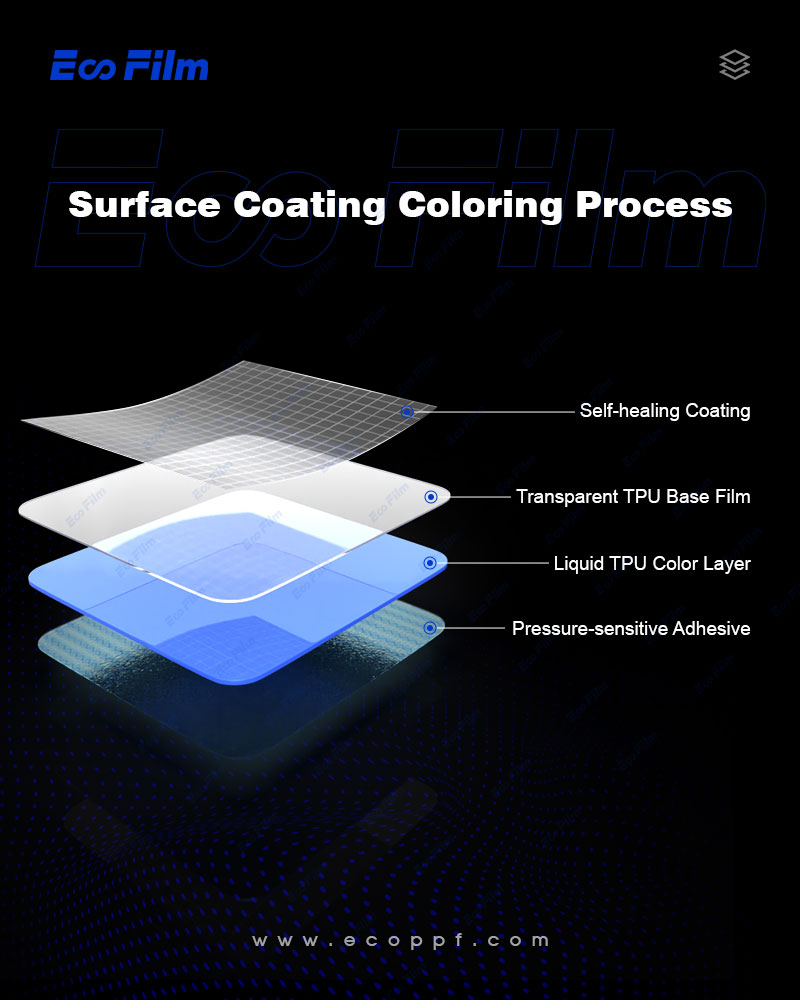
Single-layer transparent TPU + liquid TPU color layer coated on the back; currently the most common type on the market.
Structure:
Self-healing Coating + Transparent TPU Base Film + Liquid TPU Color Layer + Pressure-sensitive Adhesive.
Principle: A transparent TPU film is extruded first, then a liquid TPU color layer is coated onto the back surface of the film.
Advantages:
The liquid TPU color layer process allows highly flexible color formulation.
Only a single layer of TPU substrate is used, keeping material costs lower.
The single-layer structure delivers superior surface flatness and an excellent high-gloss finish.
Disadvantages:
The color layer is an independent coating bonded by adhesion, carrying a potential delamination risk. Under prolonged UV exposure and rainwater penetration, the color layer can separate from the TPU substrate.
The color layer sits in direct contact with the adhesive, so film removal frequently leaves residual color or stains on the car paint (alcohol test: wipe the back of the film with an alcohol-soaked tissue—color transfers immediately).
The single-layer structure is relatively thin. During high-stretch installation, the color layer is prone to "color bleeding and patchiness".
The single-layer TPU structure has weaker weather resistance and fades faster.
Direct contact between the color layer and adhesive may trigger chemical reactions over time, potentially leading to hydrolysis in severe cases.
Note: Many entry-level TPU color PPFs use this process. Under current market conditions, most products priced below $170 fall into this category.
Explore premium alternatives—including interlayer and co-extrusion options—at www.ecoppf.com.
2.Interlayer Coloring Process (Sandwich Structure, Premium Tier)
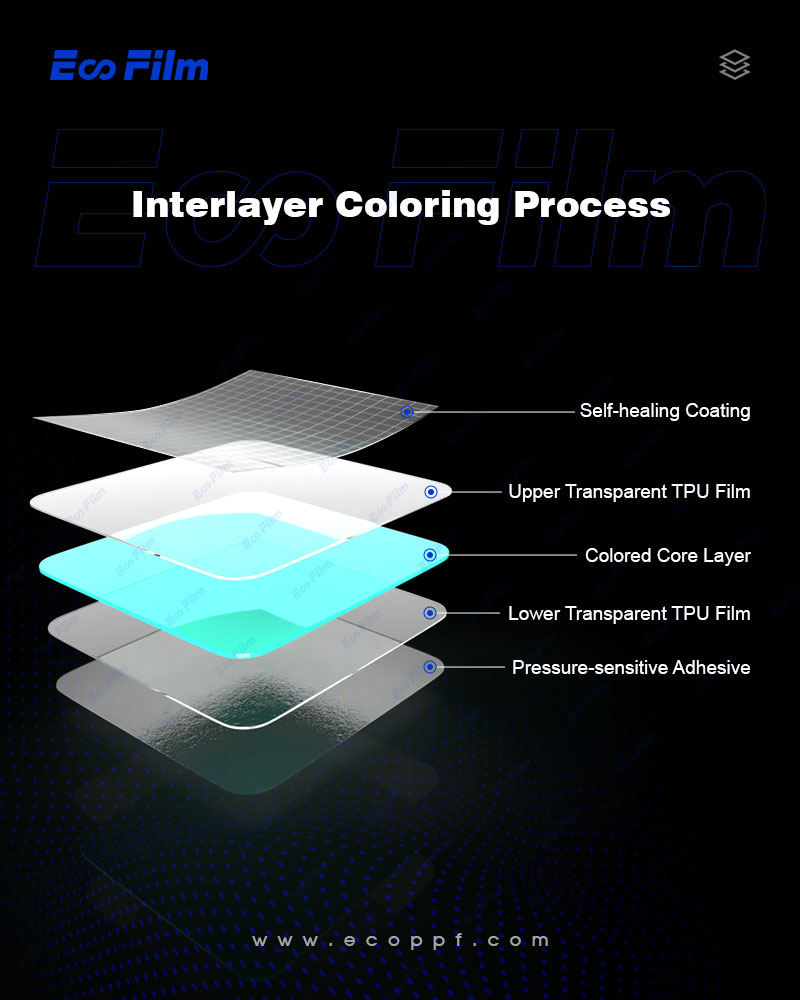
Structure:
Self-healing Coating + Upper Transparent TPU Film + Colored Core Layer + Lower Transparent TPU Film + Backing Adhesive
Principle:
A colored functional layer is sandwiched between two transparent TPU films and laminated to form a "sandwich structure."
Advantages:
Color is fully encapsulated by two TPU layers, never touching the adhesive or car paint—film removal leaves virtually no color transfer or staining.
No direct contact between the color layer and adhesive reduces the risk of chemical reactions.
Hydrolysis resistance and UV stability significantly outperform the surface coating process, with greatly enhanced anti-delamination strength.
Highly resistant to color bleeding during stretching, ensuring stable adhesion on complex curves.
Disadvantages:
An additional TPU layer plus a lower lamination yield drives costs substantially higher.
Increased overall thickness makes edge-wrapping more challenging, demanding higher installer skill.
Achieving special color-shift and metallic effects is more difficult than with the surface coating process.
3.Mass Coloring Process (Masterbatch Co-extrusion, Integrated Colored TPU Substrate)
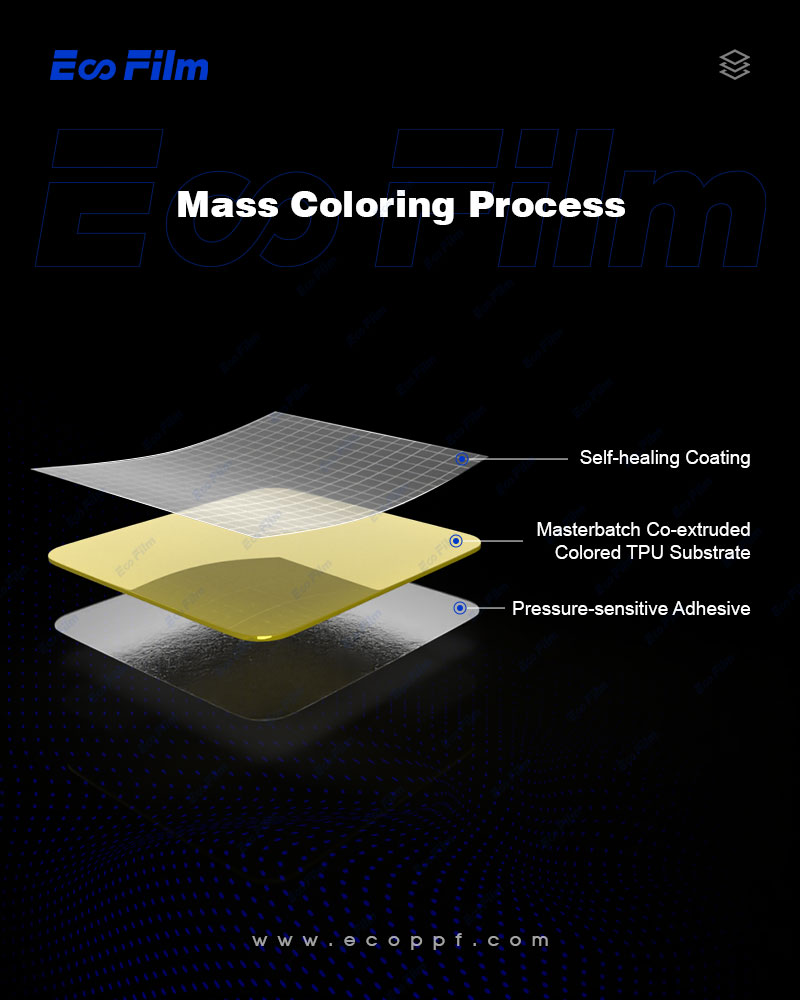
Structure:
Self-healing Coating + Masterbatch Co-extruded Colored TPU Substrate + Backing Adhesive
Principle:
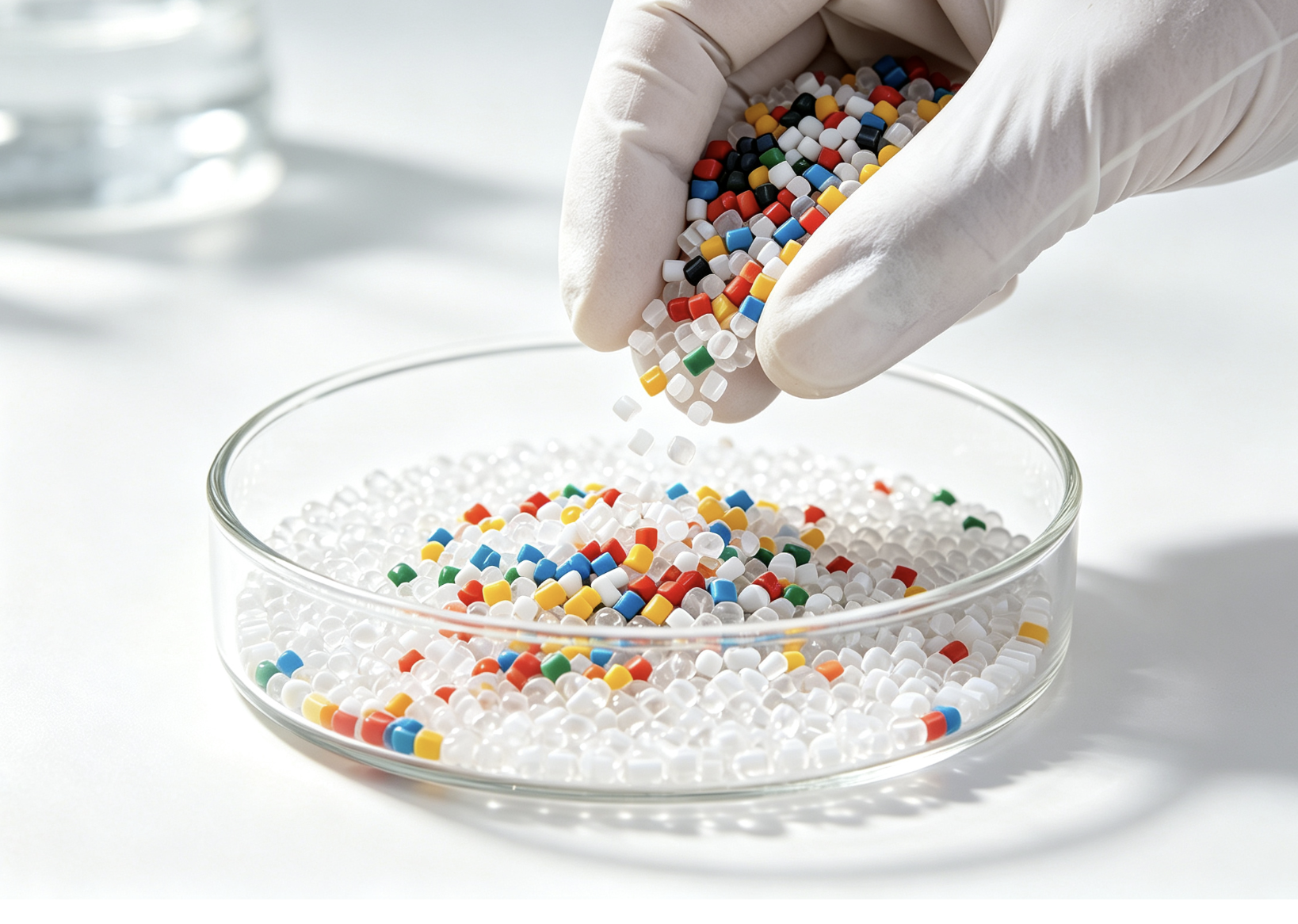
TPU pellets and weather-resistant color masterbatch are thoroughly blended in advance, then melt-extruded into a uniformly colored TPU film. Pigments are dispersed entirely within the TPU molecular matrix.
Advantages:
No independent color layer means zero risk of peeling, fading, or paint staining—the most structurally stable option.
Color remains perfectly uniform when stretched, with no whitening or bleeding.
Maximum weather resistance—premium aliphatic TPU systems claim 5–7 years of warranty (Note: warranty is a brand commitment; actual lifespan depends on environmental exposure and maintenance).
Disadvantages:
Color changeover requires a full production-line purge, making small-batch custom orders extremely costly
Difficult to produce fine pearlescent, chameleon, or multi-layer metallic textures—mainly limited to solid and crystal finishes (e.g., standard TPU gloss black is formed by co-extruding black masterbatch, not a liquid coating process)
The upper limit of color saturation is lower than that of the liquid TPU color layer process.
Reason: pigment loading has a hard ceiling. The liquid TPU process coats a functional color layer onto a clear base film, allowing high-load filling of color, pearl, and metallic powders. In the masterbatch-integrated structure, however, adding excessive masterbatch to boost visual impact would compromise the TPU molecular chain and mechanical properties.
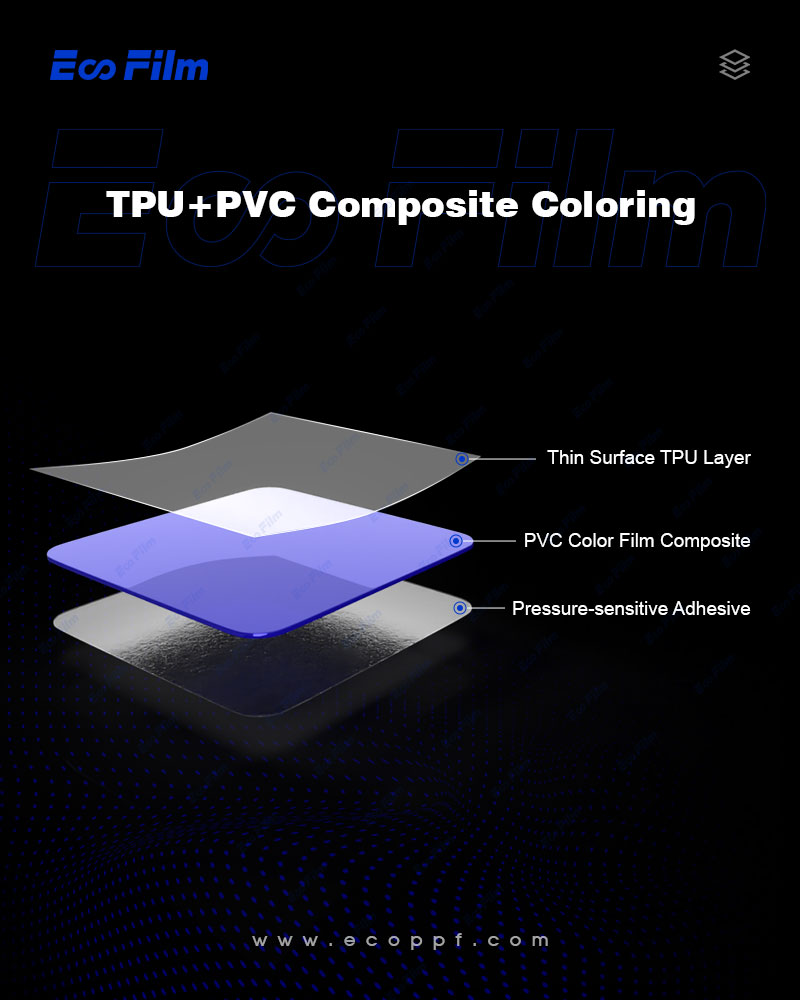
4.TPU+PVC Composite Coloring ("Pseudo-TPU" – Caution Advised)
Structure:
Thin Surface TPU Layer + PVC Color Film Composite + Backing Adhesive
Advantages:
Extremely wide color selection, low cost, and a surface appearance deceptively similar to real TPU.
Critical Drawbacks:
PVC is inherently non-weatherable—after roughly 3 years it becomes brittle, cracks, and fades severely.
Lacks the full elastic recovery of a TPU substrate, offering virtually no effective self-healing capability.
Upon aging, film removal causes massive adhesive residue and film shattering, often damaging the underlying paint.
Industry Consensus: This does not qualify as a genuine TPU color PPF and is suitable only for short-term decorative use.
Note: Non-solid-color TPU products quoted under ¥1,000 are very likely this composite type.
————————————————————————————————————
Why Choose ECOFILM – Your Trusted Source Factory!
As a leading source factory in the COLOR PPF industry, ECOFILM maintains a ready-to-ship color portfolio of over 400 options.
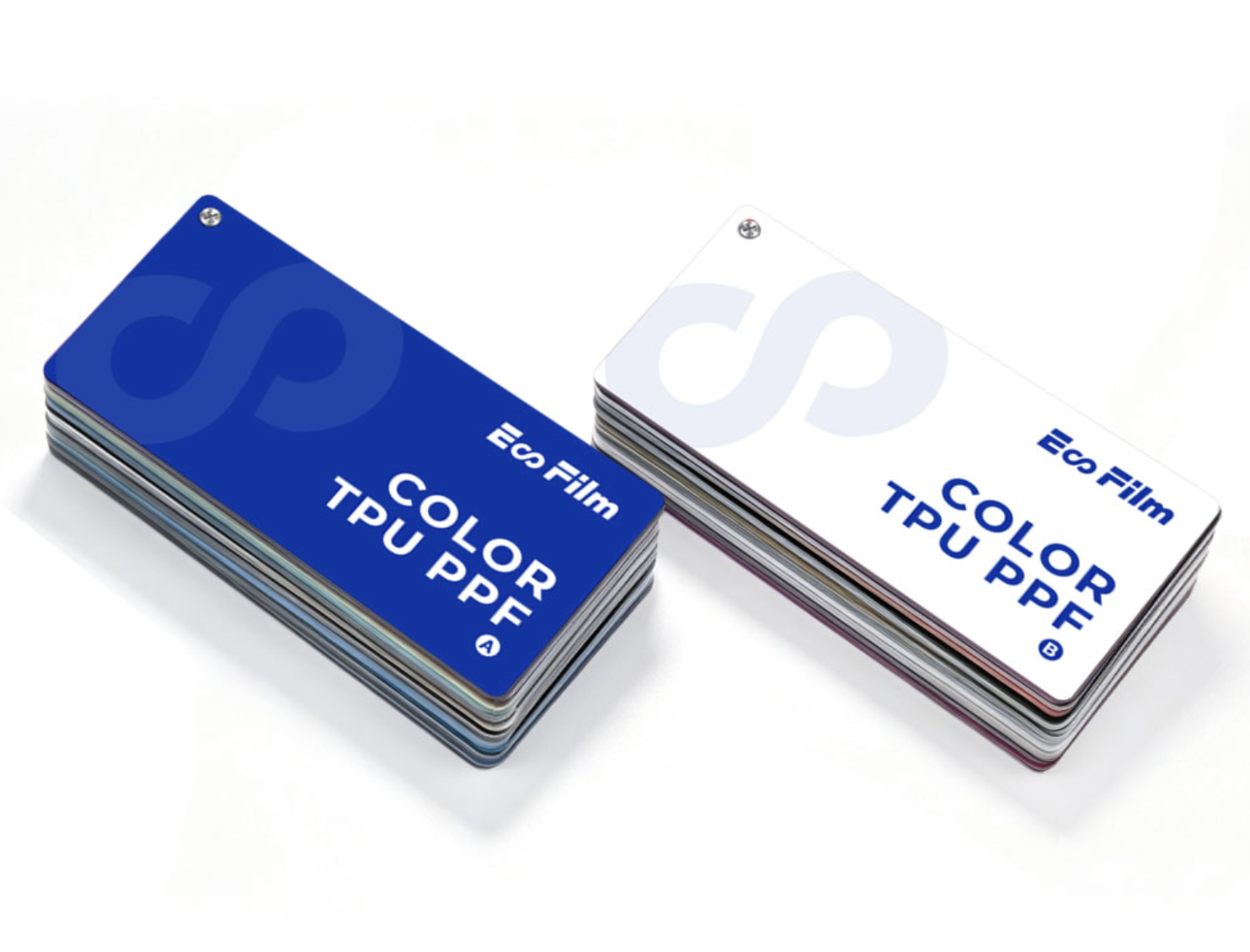
Every product is built on 100% pure TPU material, meticulously manufactured by selectively applying either the Interlayer Coloring Process or the Masterbatch Co-extrusion Process—matched optimally to each color's specific characteristics.
Whatever your procurement volume or market requirements, ECOFILM is your premium supply partner.
Website: www.ecoppf.com
WhatsApp: +86 18019014318
Email: info@ecoppf.com


