
Automotive Ceramic Film Buying Pitfalls: Heat Rejection Isn’t Everything, Craftsmanship Is Key
Why do high‑heat‑rejection ceramic films range from hundreds to thousands of dollars? Lab tests show similar heat‑rejection readings, yet real‑world vehicle performance varies drastically!
Many tint shop operators have encountered this frustrating scenario: two samples both labelled premium high‑heat‑rejection ceramic window film deliver nearly identical readings on heat‑detection equipment. One comes with a tempting low price, while the other costs several times more. However, once the low‑cost product is installed on customers’ vehicles, troubles emerge one after another. The glass appears hazy in daylight; oncoming high‑beam headlights cause harsh glare at night; some drivers observe distorted views of road scenery. Worse still, bubbling and delamination occur after a short period of use.
Most practitioners attribute these issues to poor‑quality ceramic powder raw materials. The truth, however, is that the ten‑fold price gap of ceramic films does not stem mainly from raw‑material differences. The real differentiator lies in invisible manufacturing processes: adhesive composite system, as well as nano‑ceramic powder grinding, screening and dispersion technologies.
Boasting zero signal interference, low internal reflection and stable heat‑rejection performance, ceramic window film has become a mainstream option in the automotive aftermarket. Nevertheless, the market is flooded with mixed‑quality products. Many low‑cost ceramic films cut key production procedures to lower costs and pass all risks on to downstream tint shops. This article breaks down the underlying logic of ceramic films, helping shops select suppliers beyond unit price, recognize true product quality and reduce customer complaints and rework losses.
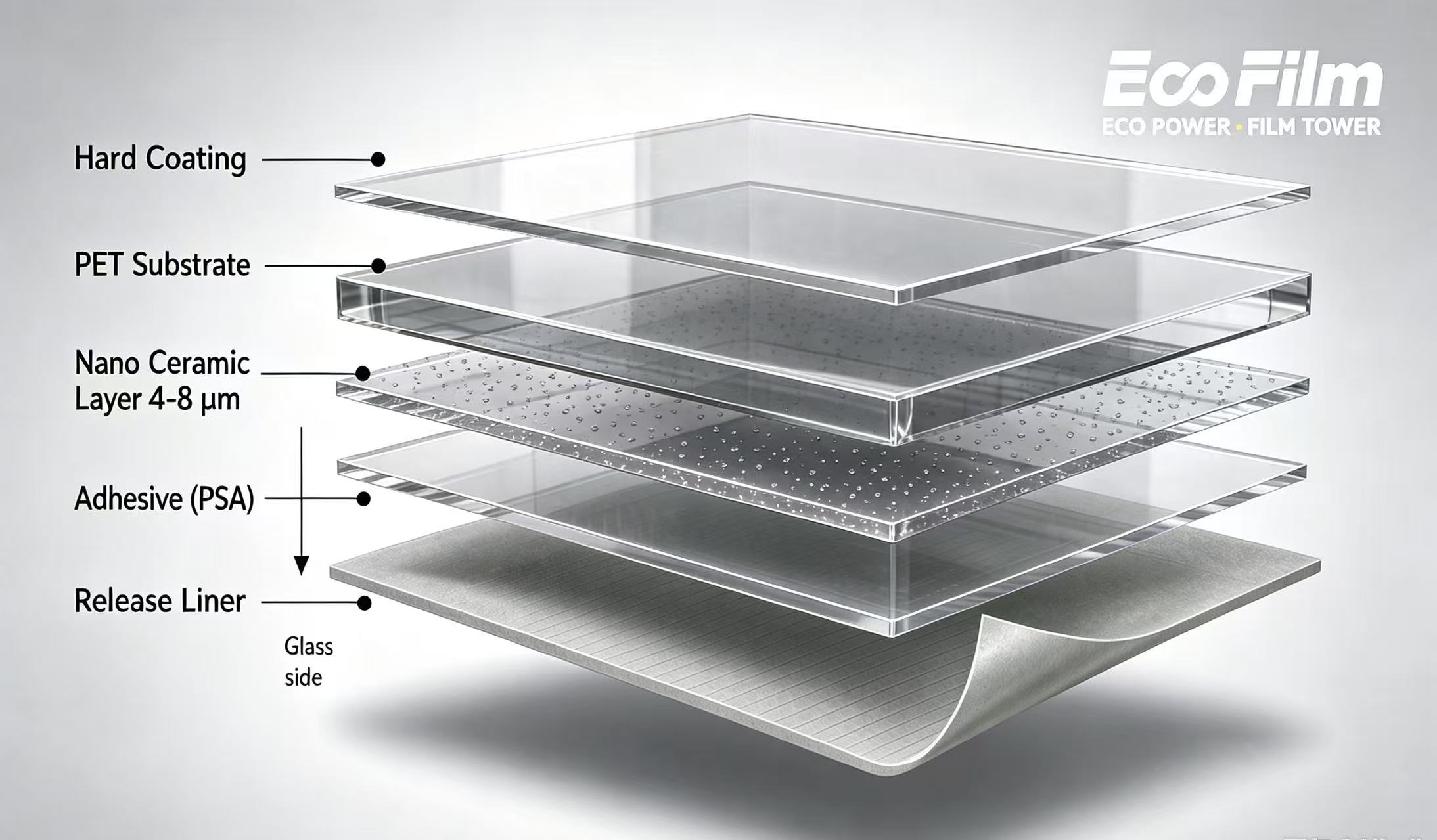
1. Adhesive System: Determines the Visual Floor of Window Film and Serves as the Root Cause of After‑sales Failures
Most shops focus on heat rejection and tint shade, yet overlook adhesive, the invisible core component. Adhesive directly triggers adhesive marks and optical distortion, and defines the service life of window film under prolonged sun exposure.
High‑grade ceramic films adopt high‑performance polyurethane composite adhesive, whose layer thickness is merely 1/5 that of ordinary acrylic adhesive. The ultra‑thin adhesive layer largely avoids adhesive marks and optical distortion caused by uneven glue thickness. When driving, road surfaces and road signs seen through the glass will not be distorted, easing eye strain during long‑distance driving. That said, polyurethane composite adhesive is extremely difficult to produce, and high yield‑loss costs are reflected in its supply price.
By contrast, numerous low‑cost ceramic films on the market adopt low‑cost thick‑layer acrylic adhesive to cut expenses. Samples show no obvious defects in laboratories or short‑term tests. Yet hidden risks surface after real‑vehicle installation: frequent adhesive marks and optical distortion lead to warped vision. Under repeated high‑temperature exposure in summer, bubbling, delamination and hydrolytic aging tend to happen. Shops save money on purchasing but suffer customer returns, rework work, labor waste and reputational damage — a net loss in the long run.
During product development, ECOFILM prioritizes stability validation of the adhesive system and never simplifies adhesive‑layer processes merely to reduce costs. Great importance is attached to adhesive uniformity and weather resistance during product selection, fundamentally lowering the occurrence of high‑frequency after‑sales problems including optical distortion, bubbling and delamination.

2. Nano‑ceramic Powder Dispersion Technology — The True Technical Barrier for Ceramic Film
When customers report hazy film and night‑time glare, most tint shops first blame poor ceramic powder quality. In fact, raw powder is only one factor. Real manufacturing strength is reflected in the complete workflow of grinding, classification screening and even dispersion of powder particles.
Many factories can grind ceramic oxides down to nano‑sized particles. Yet strict confinement of particle size within the golden range of 20‑40 nm raises technical barriers dramatically:
1.Excessively large ceramic particles: Haze surges. Car glass looks grey and hazy. At night, oncoming high‑beam lights generate severe glare, endangering night‑driving safety.
2.Excessively small ceramic particles: Heat‑rejection capacity drops sharply. Products fail to reach labelled parameters, resulting in falsely‑advertised heat‑rejectionperformance.
Cheap ceramic films skip costly fine‑screening steps, mixing oversized and undersized particles together. This creates a common industry pitfall: static lab tests on film samples achieve impressive heat‑rejection figures. Once fitted onto cars and exposed to complex real‑world light such as sunlight and vehicle headlights, haze and glare emerge. While testing devices can measure heat‑rejection rates, ordinary equipment cannot quickly detect haze or glare — a loophole exploited by inferior products.
Targeting industry pain points such as powder agglomeration and inconsistent particle sizes, ECOFILM retains complete grinding and classification‑screening procedures for its ceramic series. Despite higher production loss and costs, haze and glare risks are controlled before products leave the factory, preventing defects from surfacing after delivery to tint shops.

3. Sourcing Tips for Tint Shops & Wholesalers: Do Not Rely Solely on Heat‑rejection Data; Prioritize Manufacturing Processes and Quality Control
As an original manufacturer of window film, we fully understand sourcing demands of tint shops and wholesalers. Below are professional and practical procurement suggestions to help you pick supplies scientifically, avoid after‑sales risks and secure stable profits.
1.Balance instrument readings with real‑vehicle performance. Heat‑rejection test data is only a basic reference and cannot detect hidden defects including haze, glare and optical distortion. Test samples under strong daylight and night‑time lighting conditions. Judge product quality primarily based on actual installed visual effects.
2.Value core manufacturing processes and select reliable original manufacturers. Quality differences of ceramic films are determined by adhesive composite systems and nano‑ceramic‑powder dispersion technology. Verify manufacturer qualifications and request third‑party test reports covering haze and anti‑aging performance. Choose formal suppliers with in‑house production and full‑process quality‑control systems for consistent product quality.
3.Compare prices rationally and focus on long‑term business value. Avoid blind pursuit of low purchase prices. Low‑grade films with simplified key processes easily trigger after‑sales troubles, bringing extra rework costs and harming store reputation. Balanced high‑quality products support sustainable business growth and customer accumulation.
4.Choose well‑supported supply‑chain partners. Excellent cooperation depends not only on product performance, but also factory outgoing inspection, stable supply, technical support and after‑sales response. Reliable original manufacturers enforce strict quality control to reduce pressure for downstream tint shops and achieve win‑win collaboration.
A ten‑fold price difference for ceramic film is not only about ceramic‑powder raw materials, but also mature manufacturing workflows, strict quality‑control standards and production scrap‑loss costs.
For tint shops and wholesalers, procurement decisions should not be based merely on quotation sheets. Beyond sample testing, you need to understand the manufacturing logic behind products. ECOFILM consistently implements often‑invisible controls for adhesive formulation and powder screening. Instead of marketing based purely on sample lab data, we prioritize real‑world on‑vehicle performance.
We recognize that reliable supply‑chain cooperation means more than delivering rolls of window film. Stable supply and efficient issue response are equally vital. When factories eliminate optical defects and aging risks before shipment, tint shops can focus on high‑quality end‑customer delivery with fewer complaints and rework, realizing long‑term mutual success.


